


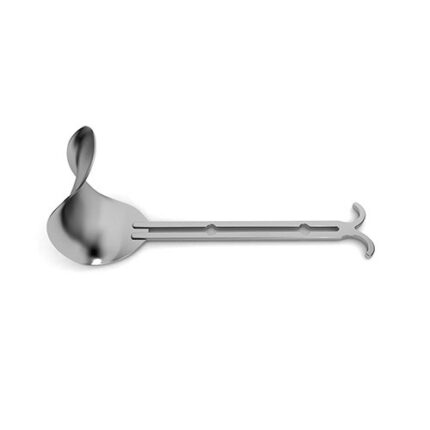
| Name | Universal Ring Retractor St. Marks Blade |
| Lead Time | 0-10 days |
| Specialty | General Instruments-Hooks & Retractors – Universal Ring Retractor System |
| Material Finish | Stainless Steel |
| Grade | Premium Operating Room |
| Units of Measurement | Each |
| Manufacturer | Ophthalmic Zone |
| Sterility | Non-Sterile |
| Usage | Reusable |

Universal Ring Retractor
w/ lip, 2-1/3″ x 7″ (5.9 cm x 17.8 cm)
Universal Ring Retractor St. Marks Blade is a long 7″ flat blade that is curved at a right-angle and contains a lip on the edge. This handle of this blade is designed to be used with a ring retractor system along with numerous other retractors to keep the edges of a wound open. This blade is particularly useful to hold open deeper incisions, such as ones in deep pelvic surgery, due to its long length and depth.
Description
Reviews (0)
Related products

Abdominal Detachable Retractor
Abdominal Detachable Retractor
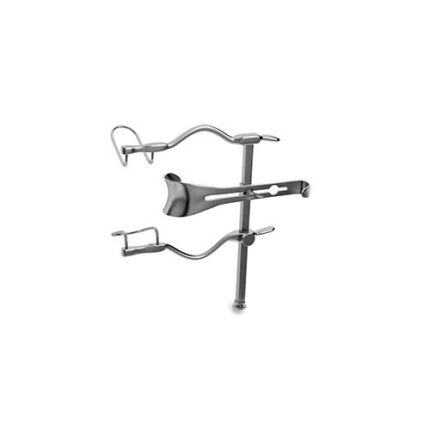
set includes: 1 pair of 2-1/2" (6.4 cm) wire lateral snap-on blades, 1 pair of 3-1/2" (8.8 cm) wire lateral snap-on blades & one (1) center blade
Balfour Abdominal Detachable Retractor is a system that includes one pair of 2 ½" wire lateral snap-on blades, one pair of 3 ½" wire lateral snap-on blades, and one center blade. The center blade is offered in a varity of sizes to accommodate patients. Its ideal function is to be used during a laparotomy in which abdominal incisions need to remain open to uncover the area. Additionally, this retractor is self-retaining, which allows it to be held in place to allow the surgeon to focus on the task and avoid holding it.
Balfour Standard Center Blade – For Fixed System
For balfour retractor systems w/ fixed side blades
Balfour Supra-Pubic Center Blade is available in different sizes to accommodate different surgical procedures and patients. The blade is curved and has lips around the edges to assist in operations such as a Suprapubic Cystostomy. This center blade may also be detached when used with the Balfour Retractor Systems.

Balfour Wide Center Blade
Balfour Wide Center Blade
for detachable balfour retractor systems
Balfour Wide Center Blade features a wide blade that comes in two different depths depending on the area that needs to be retracted. The basic purpose of this instrument is to keep the edges of an incision separate, such as those in the abdominal area. Furthermore, this center blade is specially designed for the detachable Balfour Retractor Systems.
Balfour-Baby Pediatric Abdominal Retractor
Balfour-Baby Pediatric Abdominal Retractor
Balfour-Baby Pediatric Abdominal Retractor has a maximum spread of 3 ½," which is ideal for smaller patients, such as young children. This retractor system also includes fixed fenestrated side blades that help to spread open an incision and allow for adequate inspection of the abdominal cavity.

Cushing Vein Retractor
Cushing Vein Retractor
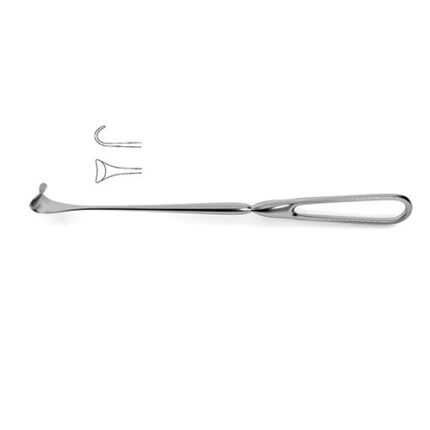
Cushing Vein Retractor has a sharply curved blade and is a popular retractor used during neurosurgery or as rib spreaders. In this way, the ribs or the tissues that are held can be pulled and kept away from the surgical area. Depending on the situation, this instrument is available in different lengths and widths.
Cushing Vein Retractor – Fenestrated Handle
Cushing Vein Retractor - Fenestrated Handle
fenestrated handle
Cushing Vein Retractor is a more light-weight instrument due to its fenestrated handle. The lengths can range from 9" to 16." This vein retractor can be used during general surgeries to retract veins or other small tissues. It may also be used in other medical procedures such as neurosurgery to pull back tissue.

Deaver Retractor – Flat Handle
Deaver Retractor - Flat Handle
flat handle, flexible
Deaver Retractor with a flat handle contains a flexible curved blade that is offered in two different widths and lengths depending on the surgical requirements. During general operations, specifically the involvement of the abdominal or chest cavity, this retractor can allow the surgeon to move one side of the incision to access the area that needs attention. If a deeper section needs to be accessed, the longer and wider blade may be more beneficial.

Deaver Retractor – Flat Handle, Curved End
Deaver Retractor - Flat Handle, Curved End
flat handle, flexible, curved end
Deaver Retractor is flexible and includes a flat handle with a curved end. This uniquely shaped retractor allows the surgeon to have a more comfortable hold while positioning it during surgeries. These surgeries typically involve areas in the deep abdominal or chest cavity. The flexible nature of the slightly curved blade may help to prevent injury to the organs area being held. In order to accommodate certain cases, this instrument is offered in various blade widths and lengths.

Reviews
There are no reviews yet.