
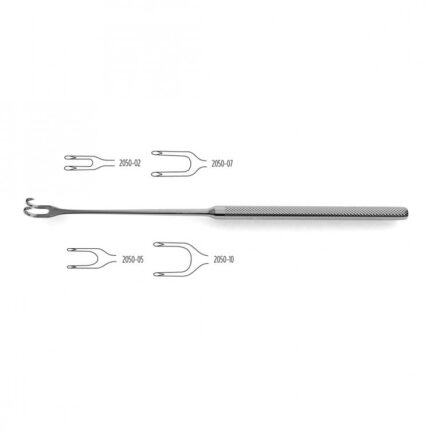
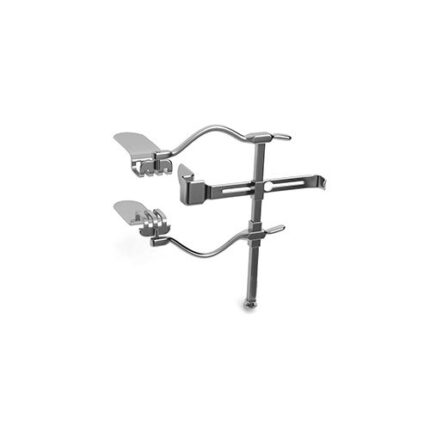
| Name | Kleinert-Kutz Hook |
| Lead Time | 0-3 days |
| Specialty | General Instruments-Hooks & Retractors – Hooks |
| Material Finish | Stainless Steel |
| Grade | Premium Operating Room |
| Units of Measurement | Each |
| Manufacturer | Ophthalmic Zone |
| Sterility | Non-Sterile |
| Usage | Reusable |
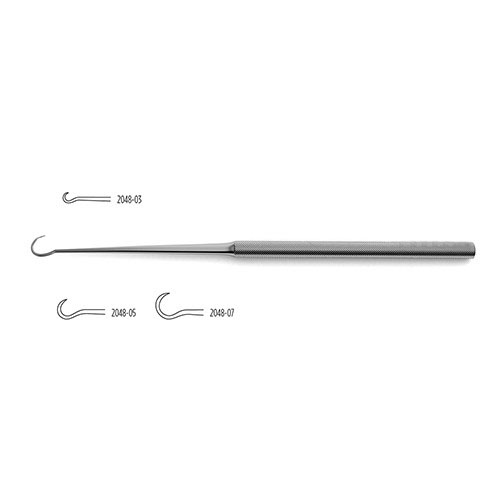
Kutz Hook
Kutz Hook
6″ (15.2 cm)
Kleinert-Kutz Hook is a 6″ long instrument with a handle that provides a better grip for the surgeon. The hook at the end is curved with a sharp pointed tip in order to grasp delicate tissue. The hook is available in small, medium, or large size to account for different scenarios.
Description
Reviews (0)
Related products
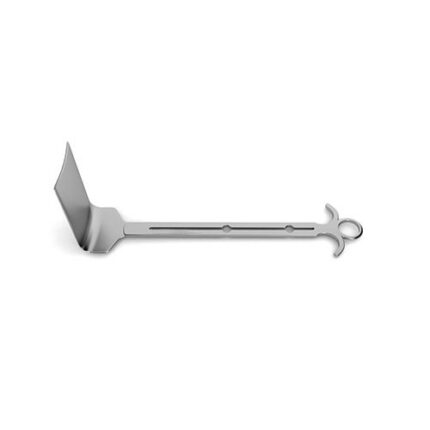
Balfour Extra-Deep Center Blades
For balfour retractor systems w/ fixed side blades, 2-3/4" wide x 4" deep
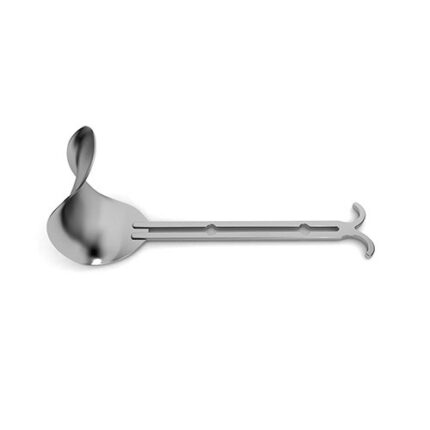
Balfour Extra-Deep Center Blades consists of a 4" deep blade that is curved at a right-angle. This blade may be intended for larger patients or for accessing deeper areas of the abdominal cavity so that they can be held in place. Another feature of this center blade is that it contains loop holes in the center slot so that it can provide different spreads.
Balfour Standard Center Blade – For Fixed System
For balfour retractor systems w/ fixed side blades
Balfour Supra-Pubic Center Blade is available in different sizes to accommodate different surgical procedures and patients. The blade is curved and has lips around the edges to assist in operations such as a Suprapubic Cystostomy. This center blade may also be detached when used with the Balfour Retractor Systems.

Balfour Supra-Pubic Center Blades
Center Blades
for balfour retractor systems w/ fixed side blade
Balfour Supra-Pubic Center Blades can be useful during procedures such as a Suprapubic cystotomy. When the bladder is retracted, this instrument provides the surgeon with a larger viewing area so that the procedure can be conducted. This blade is presented in two different sizes.
Balfour-Baby Pediatric Abdominal Retractor
Balfour-Baby Pediatric Abdominal Retractor
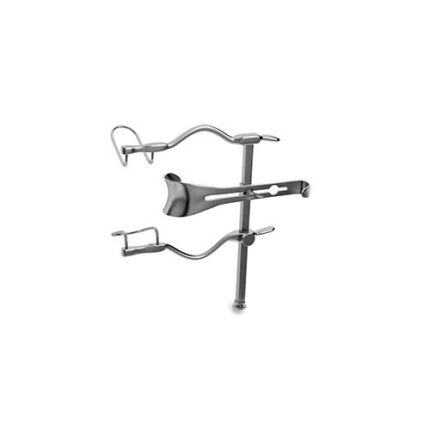
Balfour-Baby Pediatric Abdominal Retractor has a maximum spread of 3 ½," which is ideal for smaller patients, such as young children. This retractor system also includes fixed fenestrated side blades that help to spread open an incision and allow for adequate inspection of the abdominal cavity.
Davis Retractor
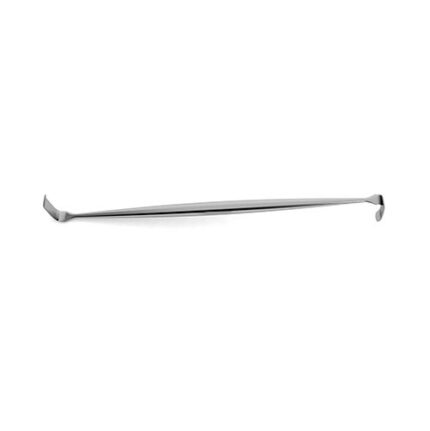
Double-ended, 5.0 mm x 16.0 mm & 8.0 mm x 21.0 mm blades, 5-1/2" (14.0 cm)
Davis Retractor is a stainless steel instrument that is double-ended and has opposing blades on either end. This retractor is able to divide and keep edges of an incision open. This instrument is also protected by the Ophthalmic Zone manufacturer warranty on defects in materials and workmanship.

Deaver Retractor – Double-Ended
Double-Ended
double-ended, 1" wide x 9" long
Deaver Retractor is typically used during abdominal procedures to keep the organs from interfering with the surgical site. This double-ended instrument has a long, curved blade on one end and a short, right angle blade on the other end. The shorter end may help to retract the walls of the bladder during intravesical surgeries, and the longer end may be helpful for deeper retractions.

Deaver Retractor – Flat Handle
Deaver Retractor - Flat Handle
flat handle, flexible
Deaver Retractor with a flat handle contains a flexible curved blade that is offered in two different widths and lengths depending on the surgical requirements. During general operations, specifically the involvement of the abdominal or chest cavity, this retractor can allow the surgeon to move one side of the incision to access the area that needs attention. If a deeper section needs to be accessed, the longer and wider blade may be more beneficial.

Glass Abdominal Retractor
Abdominal Retractor
6" (15.2 cm) x 3-1/4" (8.3 cm), 9-3/4" (24.5 cm)
B.E. Glass Abdominal Retractor contains a flexible blade with a strong curve that is affixed to a handle for gripping purposes. This type of retractor is intended to be used during surgeries that require retracting or exposing the organs in order to provide better accessibility for the surgeon.

Reviews
There are no reviews yet.